Properties
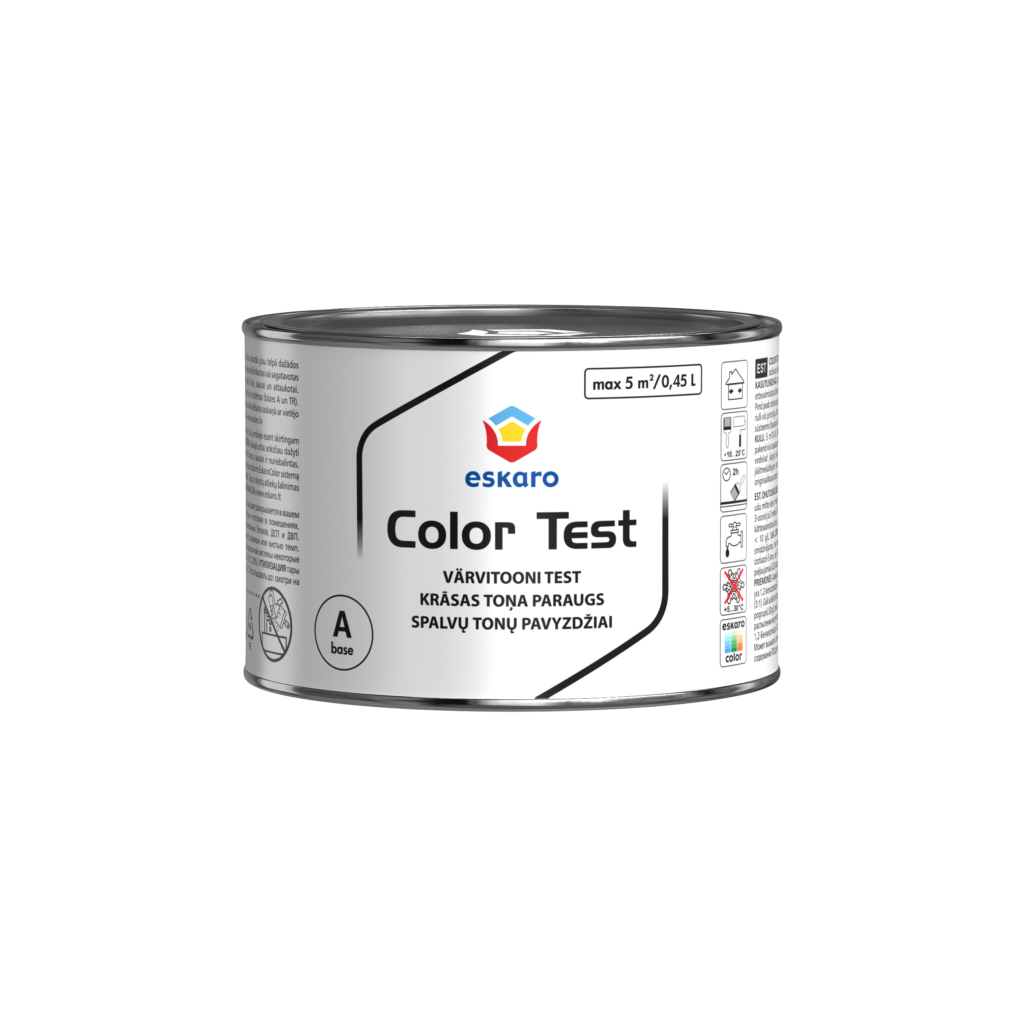
Matt water‑based paint. Allows you to assess the suitability of a colour on a small surface before painting the entire room, and to see how the selected shade appears under different lighting conditions and within the interior.
- Easy to apply; does not splatter or run
- Excellent coverage
- Dries quickly
- Almost odourless
- Allows wet cleaning after drying
- Helps avoid mistakes when choosing the colour tone
Maximum permissible VOC content for the product (subcat. a): 30g/L; maximum VOC content in the product: <10 g/L.
Purpose
For checking the colour compatibility of wall and ceiling paints in residential and public interiors.
Examples include: children’s rooms, bedrooms, living rooms, corridors, offices, workrooms, salons, halls, hotels, libraries, dormitories, shopping centres, schools, kindergartens, and similar spaces. For interior use. Not suitable for painting floors, doors, or furniture.
Types of surfaces for painting
New or previously painted concrete, gypsum board, brick, puttied, plastered, fiberglass‑wallpapered, or other paintable finishing surfaces. Primed fibreboard, chipboard, and aerated concrete.
Surface preparation before painting
The surface to be painted must be thoroughly cleaned of loose material, dirt, and dust. Previously enamel‑ or oil‑painted surfaces should be sanded to a matte finish, and sanding dust must be carefully removed. Heavily soiled surfaces, as well as those with soot, water, nicotine, or grease stains, should be cleaned with EasyClean and allowed to dry. Then prime with the insulating paint Objekt Plus. Cracks and dents should be filled with a suitable filler (Face Filler, Fine Filler, etc.). If necessary, use Biotol E or Biotol Spray to remove mould. Porous and dusty surfaces should be treated with the moisture‑insulating agent Aquastop or Tiefgrund. Please follow the instructions for all products mentioned above.
Application
Stir the paint thoroughly before use. Apply an even coat to the surface. A second coat may be required on high‑contrast substrates. Apply with a roller or brush at a temperature of +10…25 °C and at a relative humidity below 80%.
Care for the painted surface
The surface may be washed 4 weeks after painting; during this period the coating reaches its final hardness and wear resistance. After 4 weeks, the surface can be cleaned using a soft sponge or cloth. For cleaning, use water and, if necessary, neutral or mildly alkaline detergents (pH up to 9).
Do not use organic solvents. Avoid abrasive cleaners and rough sponges or brushes. Intense scrubbing may cause the surface to become glossy. After wet cleaning, dry the surface thoroughly.
Tools
Roller, brush.
Tool cleaning
Wash with soap and water after completing work.
Safety precautions
Warning! Hazardous respirable droplets may be formed when sprayed. Do not breathe spray or mist. Contains 1,2-benzisothiazol-3(2H)-one, reaction mass of 5-chloro-2-methyl-2H-isothiazol-3-one and 2-methyl-2H-isothiazol-3-one (3:1). May produce an allergic reaction. Keep out of reach of children.
Waste treatment
Paint products must always be handled with care. Do not pour into the sewage system. Do not dispose of paint or rinse painting tools in sinks or drains. Avoid release into the environment. Prevent or minimize the generation of waste. Unused paint should be taken to a waste collection point or handed over to a licensed waste handler for recycling. Reusing paint effectively reduces the environmental impact during the product’s lifecycle. Unused product is considered general waste but is not suitable for regular household waste and requires special handling. Liquid residues must be handed over to a licensed waste handler (waste code 08 01 12 – paint and varnish waste not otherwise specified under code 08 01 11). Information about collection points and waste handlers is available from the local municipality or at www.kuhuviia.ee. Dried residues may be disposed of in household waste containers. Empty, dry packaging should be taken to a packaging waste collection point for recycling (waste code 15 01). For larger quantities, please contact the Estonian Recycling Organization NGO at eto@eto.ee.
Storage conditions
Store and transport in a tightly sealed container at the temperature between +5…30 °С. Protect from exposure to freezing and direct sunlight.
The information concerning the product is based on the results of laboratory tests and practical use of the product depending on the location and conditions of its use. As the manufacturer, we guarantee the quality of the product and provide the best recommendations for its appropriate application. As the manufacturer, we cannot control the conditions and circumstances of product transportation, storage and application and numerous other factors that affect its use. Thus, we shall not bear responsibility for the damage caused by ignoring the instructions for use or transportation, by noncompliance with storage conditions and timeframes or by inappropriate application of the product. The manufacturer reserves the right to alter product information at their discretion without prior notice.